

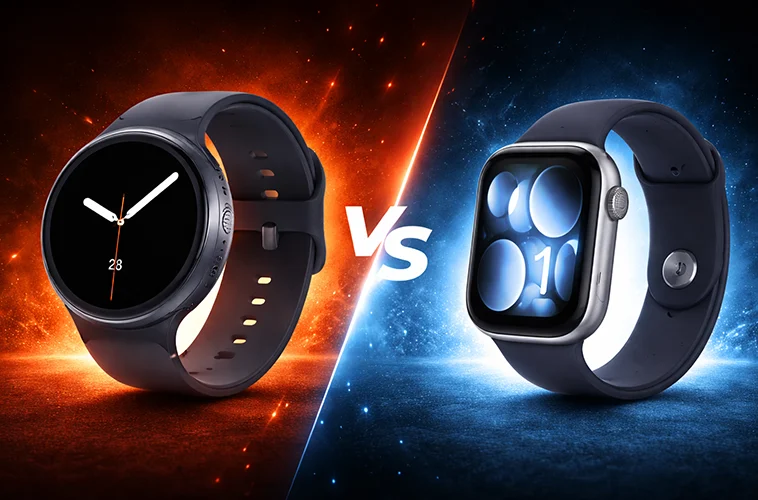
The Apple Watch Series 11 and Samsung Galaxy Watch 8 are the flagship smartwatches of 2026 from the two companies that collectively account for over 60% of the global smartwatch market.
The Apple Watch Series 11 starts at $399. The Galaxy Watch 8 starts at $299. Both track health metrics, receive notifications, support mobile payments, and integrate with their respective smartphone ecosystems. But the differences in how they work, what they track, and which phone they require are significant enough that the wrong choice can leave you with a watch that does not fully function with your phone.
This guide gives you a clear comparison so you can pick the right one.
Apple Watch Series 11 vs Samsung Galaxy Watch 8
What Are the Core Specs of Each Watch?
The Apple Watch Series 11 has a 45mm or 41mm case option, an always-on LTPO OLED display, a dual-core Apple S11 chip, up to 36 hours of battery life in standard mode (72 hours in low-power mode), 64GB of storage, and runs watchOS 11. It is water-resistant to 50 meters and includes crash detection, fall detection, and emergency SOS. The Series 11 introduced satellite messaging for emergency communication in areas without cellular coverage.
The Samsung Galaxy Watch 8 has a 44mm or 40mm case option, an always-on Super AMOLED display, an Exynos W1000 chip, up to 40 hours of battery life in standard mode (with sleep tracking enabled), 16GB of storage, and runs Wear OS 5 with Samsung’s One UI Watch 6. It is also water-resistant to 50 meters and includes crash detection, fall detection, and emergency SOS. The Galaxy Watch 8 runs a dual-frequency GPS system (L1 and L5 bands) that provides more accurate location tracking than single-frequency GPS.
Is Compatibility the Most Important Factor?
For most buyers, yes and this decision may already be made for you. The Apple Watch Series 11 requires an iPhone running iOS 17 or later. It does not work with Android phones. If you use a Samsung or any other Android phone, the Apple Watch is not an option. The Galaxy Watch 8 works best with a Samsung Galaxy phone running Android 11 or later, though it is compatible with any Android phone running Android 10 or later. Full functionality including ECG, body composition analysis, and Samsung Health integration requires a Galaxy phone specifically.
If you have an iPhone, the Apple Watch Series 11 integrates more deeply with your phone than any other watch — it receives all notifications, uses your iPhone’s cellular connection for calls and data when they are on the same network, and connects natively to iMessage, Apple Pay, and all iOS apps. If you have a Samsung Galaxy phone, the Galaxy Watch 8 offers the same depth of integration on the Android side — calls, messages, Samsung Pay, Bixby, and deep health data sharing with Samsung Health.
How Do the Health Tracking Features Compare?
Both watches track heart rate continuously, blood oxygen levels (SpO2), sleep stages, stress, menstrual cycles, and activity metrics. Both include ECG (electrocardiogram) for detecting irregular heart rhythms. The differences are in depth and exclusives.
The Apple Watch Series 11 added wrist temperature sensing for improved ovulation and cycle tracking, and the Apple Health ecosystem is considered the most comprehensive health data platform available — connecting data from hundreds of third-party apps, medical providers, and clinical research studies. Apple Watch’s AFib detection and irregular heart rhythm notifications have a longer FDA-cleared track record than Samsung’s equivalent features.
The Galaxy Watch 8 includes body composition analysis — it can measure body fat percentage, skeletal muscle mass, and body water percentage directly from the watch using bioelectrical impedance, which the Apple Watch does not offer. It also has dual-frequency GPS (more accurate for outdoor sports) and the Energy Score feature, which gives a daily readiness score based on sleep, heart rate variability, and activity recovery. Galaxy Watch’s sleep coaching is more detailed than Apple’s, providing specific behavioral recommendations rather than just data.
How Does Battery Life Compare?
Battery life is a meaningful difference between the two. The Galaxy Watch 8 lasts up to 40 hours in normal use and around 72 hours in power-saving mode. The Apple Watch Series 11 lasts up to 36 hours in standard mode and 72 hours in low-power mode. Day-to-day, both watches require nightly or every-other-night charging for most users who use GPS tracking and always-on display.
Neither watch is a multi-day battery champion — if you want a watch that lasts a week, the Garmin Fenix or Fitbit Charge series are designed for that use case. For the Apple Watch and Galaxy Watch 8, battery management is a daily consideration rather than a concern you can set and forget.
How Does the App Ecosystem Compare?
Apple Watch has a significantly larger app ecosystem. The App Store for Apple Watch has tens of thousands of apps spanning fitness, productivity, navigation, payments, and entertainment.
Third-party developers have built for Apple Watch since 2015, giving it a 10-year head start on platform maturity.
Wear OS on the Galaxy Watch 8 has improved significantly since Google and Samsung aligned on a unified platform in 2021, but the app selection is still smaller than watchOS. Most major apps — Spotify, Strava, Uber, Google Maps — are available on both platforms.
Which One Should You Buy?
Buy the Apple Watch Series 11 if you have an iPhone and want the deepest possible integration between your phone and watch;
- if health data tracking connected to Apple Health’s broader ecosystem matters to you;
- if app variety and platform maturity are priorities;
- or if you want the most accurate AFib detection and FDA-cleared health monitoring features.
The $399 starting price is higher than the Galaxy Watch 8, but the Apple Watch ecosystem justifies it for iPhone users. For Apple Pay users specifically, the watch also extends Apple Pay to your wrist — the same payment system you can use at the millions of retailers that accept Apple Pay.
Buy the Samsung Galaxy Watch 8 if you have an Android phone (and especially a Samsung Galaxy phone);
- if body composition tracking is important to you;
- if you want more detailed sleep coaching;
- if GPS accuracy for outdoor sports matters;
- or if the $299 starting price is a deciding factor.
The Galaxy Watch 8 is the best Android smartwatch available in 2026 and covers every meaningful health and notification feature that most users need at a $100 lower entry price than the Apple Watch Series 11.
