

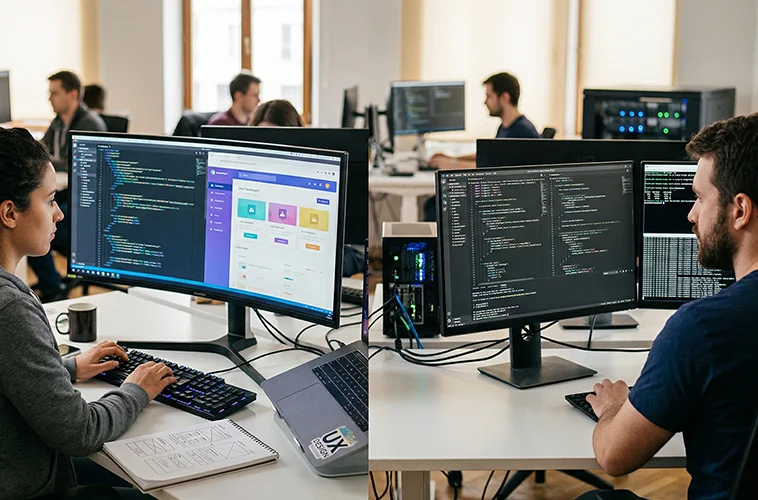
If you’ve spent any time around web development, you’ve heard these two terms thrown around constantly. Front-end. Back-end. Sometimes full-stack. But what do they actually mean? And more importantly, why does it matter for you? Whether you are thinking about a career in tech or just trying to understand how websites work, this guide gives you clear idea comparing what is front-end vs back-end development.
What Is Front-End Development?
Front-end development is everything you see and interact with on a website or app. The buttons you click, the text you read, the images you scroll past, the menu that drops down — all of that is built by a front-end developer. It’s the visual, interactive layer of any digital product.
Front-end developers write code that runs directly in your browser. When you visit a website, your browser downloads that code and displays it on your screen. That’s why front-end development is also called client-side development. Here the “client” is your browser or device.
The three core tools of front-end development are HTML, CSS, and JavaScript. HTML builds the structure (headings, paragraphs, buttons). CSS controls the style (colors, fonts, layout). JavaScript adds interactivity (animations, form validation, real-time updates).
According to ELITEX, you’ll find HTML, CSS, and JavaScript in 99% of web products — they are the building blocks of every website you visit.
What Is Back-End Development?
Back-end development is everything that happens behind the scenes — the parts of a website you never see but rely on every single time you use it. When you log into an account, the back-end checks your password. When you place an order, the back-end processes the payment and updates the inventory. When you load your Instagram feed, the back-end fetches the right posts from a database and sends them to your screen.
Back-end developers work with servers, databases, and APIs. Their code runs on a remote server not your browser which is why back-end development is also called server-side development. The back-end is the engine. You don’t see it, but nothing works without it.
Common back-end languages include Python, Java, PHP, Ruby, and Node.js (JavaScript on the server side). Back-end developers also work heavily with databases like MySQL, PostgreSQL, and MongoDB to store and retrieve data.
Front-End vs Back-End: Side-by-Side Comparison
Here’s a quick look at how the two sides compare across the most important areas:
| Area | Front-End | Back-End |
|---|---|---|
| What it does | Builds what users see and interact with | Manages data, logic, and server operations |
| Runs on | Browser (client-side) | Server (server-side) |
| Core languages | HTML, CSS, JavaScript | Python, Java, PHP, Ruby, Node.js |
| Common frameworks | React, Vue, Angular, Next.js | Django, Express, Spring, Laravel |
| Works with | UI design, user experience, browsers | Databases, APIs, servers, security |
| Visible to user? | Yes — everything on screen | No — runs in the background |
| Average US salary | ~$89,000/year | ~$89,000–$100,000+/year |
How Do Front-End and Back-End Work Together?
Every time you interact with a website, both sides are working at the same time. Here’s a real example — say you log into your email:
- You type your email and password into a form. That form is built by the front-end.
- You click “Sign In.” The front-end sends your login details to the server via an API call.
- The back-end receives the request, checks your credentials against the database, and confirms they match.
- The back-end sends a response back “login successful” along with your account data.
- The front-end receives that data and displays your inbox on screen.
Neither side could do this alone. The front-end needs the back-end to fetch real data. The back-end needs the front-end to give users a way to interact with that data. They’re two halves of the same product.
What Is a Full-Stack Developer?
A full-stack developer works on both the front-end and the back-end. They can build an entire web application from start to finish designing the interface, writing the server logic, and setting up the database. Full-stack developers are highly valued because they can see the whole picture and move between both sides of the codebase without needing to hand off work.
That said, being full-stack doesn’t mean being equally expert in everything.
Most full-stack developers have a stronger side either front or back and competent skills on the other. The average salary for front-end and back-end developers in the US is around $89,000 per year, according to Analytics Insight, with back-end roles sometimes paying higher at complex-systems companies.
Which One Is Easier to Learn for Beginners?
Front-end development is generally considered the easier starting point for beginners. The results are immediate and visual you write some HTML and CSS, open a browser, and see exactly what you built. That fast feedback loop makes learning more motivating and less abstract.
Back-end development has a steeper early learning curve. You’re dealing with servers, databases, APIs, and logic that produces no visible output until everything is connected properly. It’s more rewarding once things click, but it takes longer to get to that point.
Most coding bootcamps and beginner programs start with front-end for this exact reason. Once you understand how the browser works and how JavaScript handles logic, making the jump to back-end concepts becomes much more manageable.
Which Path Should You Choose?
The right path depends on what kind of work appeals to you not on which pays more or which is more in demand, because both have strong job markets.
- Choose front-end if you enjoy visual design, care about user experience, like seeing your work on screen, and want to work closely with designers.
- Choose back-end if you enjoy logic and problem-solving, like building systems and data pipelines, and don’t mind that your work runs invisibly in the background.
- Choose full-stack if you want flexibility, enjoy both sides, and want to be able to build complete products independently.
There’s no wrong answer here. Front-end is great for people who enjoy creativity and visual work. Back-end suits those who prefer systems thinking and technical depth. Many developers start on one side and naturally expand to the other over time.
Do You Need to Learn Both to Get a Job?
No. Companies hire front-end developers and back-end developers as separate roles every day. You don’t need to know both to get hired. Most junior developer job listings are specific, they ask for a front-end developer with React experience, or a back-end developer with Python and PostgreSQL. Specializing in one area and building strong skills there is a solid, practical path to employment.
That said, having a basic understanding of both sides makes you a better developer and a better collaborator. A front-end developer who understands how APIs work will write better code. A back-end developer who understands what the front-end needs will design cleaner data responses. You don’t need to master both, but knowing the basics of each helps.
What Should You Learn First?
If you’re starting from zero, begin with front-end. Learn HTML and CSS to understand structure and styling. Then pick up JavaScript to add interactivity. Once you’re comfortable with JavaScript, you’ll have a strong foundation whether you go deeper into front-end frameworks like React, or pivot to back-end development with Node.js.
Front-end and back-end development are two distinct disciplines, but they build the same thing together. Knowing what each one does, and which one fits your interests, is the first step to figuring out where you want to go in tech.
