

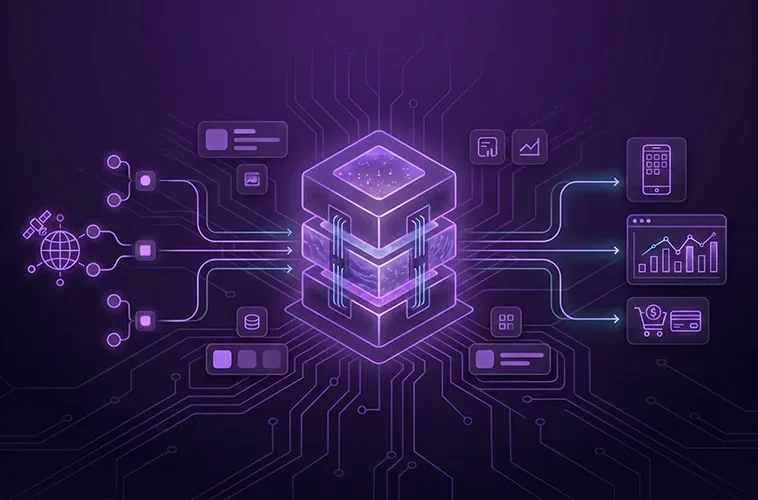
A database is an organized collection of structured information stored electronically so that it can be accessed, managed, and updated efficiently. Every application that stores data uses a database. Instagram stores your photos in one, and your email provider stores your messages in one.
Currently, there are over 350 database management systems in active use, but the fundamental split that matters most for any developer or business owner to understand is the difference between SQL and NoSQL databases.
What Is a Database and Why Does Every Application Need One?
A database is the layer of software that sits between your application and the raw data it needs. Without a database, data would have to be stored in files which works for a single user but becomes chaotic and unreliable the moment multiple users try to read and write data at the same time.
Databases solve this by providing structured storage, controlled access, data integrity rules, and query capabilities that let you retrieve exactly the information you need without loading everything into memory first.
A database management system (DBMS) is the software that creates and manages the database. When developers say “we use MySQL” or “we use MongoDB,” they are referring to a DBMS — the actual engine that stores, indexes, and retrieves data.
The database is the data; the DBMS is the software that manages it. Both together are commonly just called “the database” in everyday usage.
What Is a SQL Database?
SQL stands for Structured Query Language. A SQL database also called a relational database stores data in tables made of rows and columns, similar to a spreadsheet.
Each table represents a specific type of data (customers, orders, products), and tables are linked to each other through defined relationships using keys. The word “relational” refers to these relationships between tables, not to relationships between people.
SQL databases enforce a strict schema, a predefined structure that every row in a table must follow. If your table has columns for first name, last name, and email, every row must have values that fit those columns and their data types. This structure enforces data consistency: you cannot accidentally store a phone number in an email field.
You interact with a SQL database by writing queries in the SQL language. A simple query to fetch all customers from California looks like this: SELECT * FROM customers WHERE state = 'CA'. SQL is powerful enough to filter, sort, aggregate, join, and transform data across multiple tables in a single query.
The most widely used SQL databases in current time are PostgreSQL, MySQL, Microsoft SQL Server, and SQLite.
What Is a NoSQL Database?
NoSQL stands for “Not Only SQL.” NoSQL databases were developed to handle data types and access patterns that relational databases were not designed for massive scale, unstructured or variable data, and high-speed reads and writes across distributed systems. NoSQL databases do not require a fixed schema, which means each record can have a different structure. They also do not always use SQL as their query language — different NoSQL systems have different query APIs.
NoSQL databases come in four main types, each optimized for different use cases.
- Document databases: Store data as JSON-like documents. Each document can have a different structure. MongoDB is the most popular document database, widely used for content management, user profiles, and product catalogs.
- Key-value databases: Store data as simple key-value pairs, like a dictionary. Extremely fast for read and write operations. Redis is the most popular key-value database, used for caching, session storage, and real-time leaderboards.
- Column-family databases: Store data in columns rather than rows, optimized for reading specific columns across millions of rows. Apache Cassandra, used by Netflix and Instagram at scale, is the leading example.
- Graph databases: Store data as nodes and edges, optimized for highly connected data like social networks or recommendation engines. Neo4j is the most widely used graph database.
What Are the Key Differences Between SQL and NoSQL?
The differences between SQL and NoSQL come down to structure, scalability, and use case fit rather than one being objectively better than the other.
SQL databases have a fixed schema that must be defined upfront, store data in structured tables with defined relationships, scale vertically (by adding more power to a single server), guarantee ACID transactions (Atomicity, Consistency, Isolation, Durability) which make them reliable for financial and transactional data, and are best suited for structured data with clear relationships — accounting systems, e-commerce platforms, CRMs, and HR systems.
NoSQL databases have a flexible schema where each record can have different fields, store data in documents, key-value pairs, columns, or graphs depending on type, scale horizontally (by adding more servers to a distributed cluster), sacrifice some ACID guarantees in exchange for speed and scale in most implementations. It is best suited for unstructured or rapidly changing data like social media feeds, IoT data, real-time analytics, and content management.
Which Type of Database Should You Use?
The right choice depends on the shape of your data and how your application needs to access it.
Use a SQL database when your data has clear relationships between entities, when data integrity and consistency are critical (financial transactions, inventory, medical records), when your queries are complex and involve joining multiple tables, or when your team is more familiar with relational modeling.
PostgreSQL is the default recommendation for most new SQL projects — it is open source, highly capable, and widely supported.
Use a NoSQL database when your data structure varies from record to record, when you need to scale to millions of users with distributed infrastructure, when you are storing large volumes of simple data (session data, logs, events), or when your access patterns are simple and do not require complex joins.
MongoDB is the most common starting point for NoSQL applications. Redis is the standard for caching layers regardless of whether your primary database is SQL or NoSQL.
Languages like Python have mature libraries for working with both types, and most applications access databases through APIs that abstract the database layer away from the end user entirely.
Many production applications use both — a relational database for core transactional data and a NoSQL database for specific needs like caching (Redis), search (Elasticsearch), or user activity logs (Cassandra).
The choice is not always either/or.
